Hermann van Pels
Diary of Anne FrankHermann van Pels, called Mr. van Daan in the published diary, is the head of the van Pels family, which joins the Franks in the Secret Annex in July 1942. In Anne Frank’s account he emerges through intimate domestic particulars: the family’s arrival with a tea table, a quarrel over Peter’s refusal to come downstairs, and a birthday celebrated with carefully saved food. The diary’s changing names and publication history also make him a figure in the layered making of the book. After the residents’ arrest, historical material in the edition records that he was murdered at Auschwitz in late 1944.
Identity and Place in the Diary
Hermann van Pels was born on March 31, 1889. The book’s foreword explains that Anne Frank used pseudonyms in her rewritten diary: she called him Hans van Daan in her manuscript and Hermann van Daan in the published-book version. The definitive edition identifies him by his real name, while retaining the familiar pseudonym where discussing the diary’s earlier publication history. These naming layers matter because readers encounter his role both as a person in the Annex and as a character presented through Anne’s edited account.
He enters the story as one of the two adults accompanying Peter van Pels, Anne’s initially dismissive description of whom is that he is shy and awkward. The family had intended to join the Franks on July 16, but call-up notices and the resulting unrest led them to leave earlier. They arrived on July 13, while the Frank family was at breakfast: Peter came first, and Hermann and Auguste followed half an hour later. Their arrival expanded the hidden household from four people to seven, before Fritz Pfeffer joined later.
Arrival and Shared Domestic Life
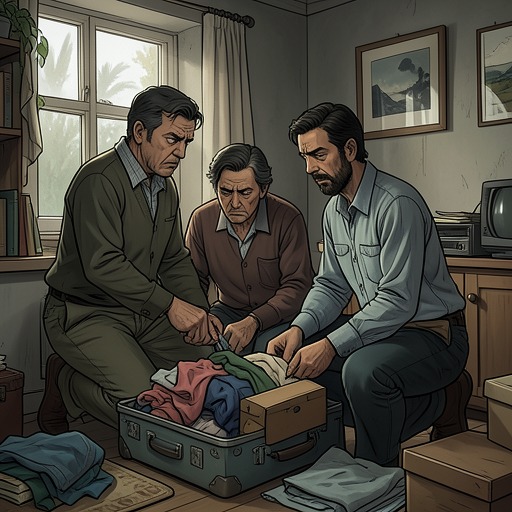
The first account of Hermann’s arrival gives him a comic, practical counterpart to his wife’s conspicuous chamber pot: he carried a collapsible tea table under his arm. Anne records that the families began eating together at once and that, after three days, the seven residents felt like one large family. The tea table and the shared meals register the Annex not as an abstract refuge but as a household that had to be improvised from the belongings brought in and the routines its occupants established.
That domestic arrangement did not eliminate conflict. In one episode Peter stayed upstairs after a disagreement, while the others continued their meal. When a whistle and Peter’s voice signaled his refusal to come down, Hermann sprang up, his napkin falling, and shouted that he had had enough. Otto Frank took him by the arm and accompanied him to the attic; after a struggle, Peter was back in his room and the meal continued. Hermann’s anger is visible in the abrupt interruption of the shared table, while the intervention of Anne’s father keeps the confrontation from escalating further in the scene.
The episode also reveals a disagreement over authority and care. Auguste wanted to save bread for her son, but Hermann insisted that Peter apologize or sleep in the loft. His response is severe, yet the account places it inside a family argument witnessed by the whole household, not in isolation. The quarrel shows how the close quarters made parental discipline and private family tensions part of everyone’s daily life.
Pressure, Routine, and Relationships
The residents’ ordinary arrangements existed under occupation and threat. Anne describes anti-Jewish decrees that restricted movement, transport, shopping hours, schooling, and access to public life. The Franks’ own plan to hide had to be advanced by ten days after Margot received a call-up notice; the hiding place was in Otto Frank’s office building. The van Pels family’s early arrival likewise reflects the danger created by call-up notices. Hermann’s life in the diary is therefore shaped by a practical contradiction: the household tries to establish meals, rules, and family routines in a place where discovery could end that temporary domestic order.
When the residents learned of a burglary, their security routine required them to remain quiet, avoid washing or running water, get dressed by eight, and stay away from the bathroom. Peter noticed that the warehouse and street doors were open and alerted Otto Frank. The burglars had forced doors with a crowbar and stolen cashboxes, blank checkbooks, and sugar coupons representing the group’s entire 330-pound allotment. The diary does not single Hermann out as the person directing this response; rather, the incident shows the shared rules and material vulnerabilities governing his household as well as the others.
After another security crisis, the residents considered a barricade made from the white Frankfurt bedsteads, whether the night watchman could be trusted, and whether dogs would bark at someone behind the door. Peter was assigned to patrol the building, the residents were told not to go downstairs, and the group was reminded that a window left open had been noticed. Such changes made the Annex’s physical routines more restrictive. Hermann appears within this collective response, living under rules designed to reduce the risk of detection rather than exercising freedom in any ordinary sense.
Birthday and Shifting Relations
A later birthday entry gives a contrasting view of Hermann through the presents assembled by the residents. He received two packets of tobacco, a serving of coffee saved by his wife, lemon punch from Mr. Kugler, sardines from Miep, eau de cologne from the Franks, flowers, and a raspberry-filled cake. The cake was slightly gluey because of poor flour and the lack of butter, yet Anne still describes it as delicious. The gifts are modest and contingent on scarcity; their variety also shows the group sustaining a shared social occasion inside confinement.
The same entry notes that talk about Anne and Peter had quieted and that Peter was coming to fetch her, despite his dislike of doing so. Anne describes them as very good friends who could discuss delicate subjects openly. This is not a direct account of Hermann’s relationship with Anne, but it places his birthday within a household whose emotional ties were changing: alongside adult worries and family disagreements, younger residents were forming an intimacy that Anne valued.
Arrest and Fate
The residents’ concealment ended with their arrest on August 4, 1944. The edition’s historical account says they were taken first to a prison in Amsterdam and then deported to Westerbork. On September 3, the eight residents left Westerbork in its last transport to Auschwitz, arriving three days later. These later facts come from the book’s retrospective material, distinct from Anne’s diary entries, which stop on August 1, 1944.
According to Otto Frank’s testimony, Hermann van Pels was killed in the gas chambers at Auschwitz in October or November 1944, shortly before they were dismantled. The diary’s domestic scenes cannot narrate that ending: they preserve him in the midst of meals, disputes, birthday gifts, and security precautions, while the edition’s historical account establishes the fate that followed. That divide between the close-grained household record and the later confirmation of his death marks the limit of Anne’s firsthand narrative and the cost of the arrest.